
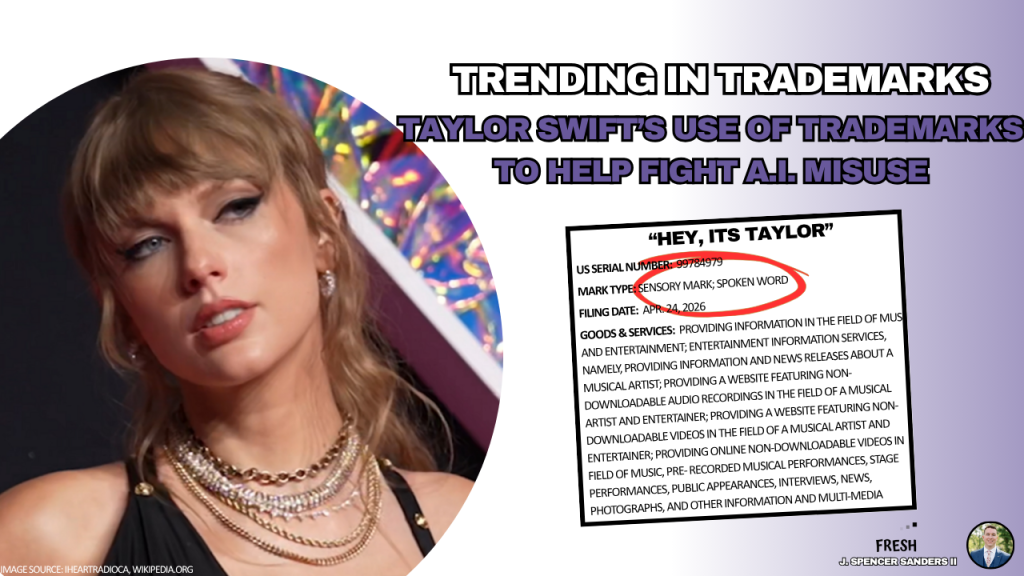
Taylor Swift’s name is brought up often in various contexts: awards shows, tabloids, NFL games (to the chagrin of some NFL fans), and, weirdly enough, IP law circles. Taylor’s name and, more importantly here, her voice and overall image, are once again on the minds of trademark attorneys as she becomes among the first celebrities to rely on trademark law as a means of protecting herself and her brand from the threats posed by Artificial Intelligence.
On April 24, the singer filed three trademark applications (U.S. Ser. Nos. 99784980, 99784979, and 99784977). Two separate applications for her voice saying “Hey, it’s Taylor Swift” and “Hey, it’s Taylor,” and another for a specific visual image of her “holding a pink guitar, with a black strap and wearing a multi-colored iridescent bodysuit with silver boots. She is standing on a pink stage in front of a multi-colored microphone with purple lights in the background.”
The Filed Image
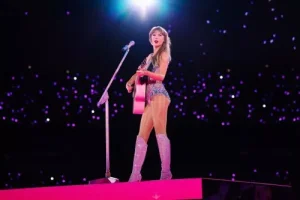
USPTO: US Serial Number 99784977
The timing of the filings is topical. In a world where AI models are increasingly being used to create unauthorized content featuring the voices and likenesses of celebrities to sell products, indicate endorsement, or worse; actors, musicians, and influencers alike are scrambling to find better ways to better protect themselves from bad actors. While existing “Right of Publicity” laws exist, they may not be enough. It has become apparent that a different strategy is necessary. Swift and her team are looking to use the trademark system to build another layer of protection against any nefarious or confusing use of her likeness.
Swift isn’t the only celebrity following this strategy. Since January of this year, actor Matthew McConaughey has filed and registered several similar trademarks including one featuring the actor reciting his infamous “alright alright alright” quote from Dazed and Confused. The goal, McConaughey says, is to ensure that any use of his likeness or voice would require his approval, citing fears of use of his distinctive Texan twang to indicate his endorsement or sponsorship of a product. This would be especially important for such a prominent pop-culture figure as McConaughey, as he has appeared and is heard in marketing for various products including Lincoln Motor Company, Uber Eats, Salesforce, and Wild Turkey Whiskey. He also has his own business venture of Pantalones Tequila, various philanthropic projects, ownership in Austin FC of Major League Soccer and is deeply connected with the University of Texas serving as a “professor of practice” and cultural figurehead of sorts. His voice and likeness are certainly worth a lot of money, but confusion as to his endorsement could serve to harm not only his reputation but that of a number of third-parties, companies, and organizations he cares deeply about.
These non-traditional “sound marks” as they are known are by no means a new concept. NBC’s three note chime was first registered in 1950 with the current iteration being registered in 1971, MGM has had their roaring lion sound mark registered since 1986, and the Globetrotters secured protection for the “Sweet Georgia Brown” melody in 1992. They are, however, relatively rare and this is certainly the first time these types of marks have been used specifically in this way. As such, they are a novel question for both the United States Patent and Trademark Office and the Courts. Should the applications get through to registration with the USPTO, we are likely to see a number of high-profile challenges if/when Taylor decides to attempt to enforce her rights on potential infringers.
Copyright law, for the time being, remains the standard when it comes to protecting a musician’s rights in their music. The application of existing copyright law to AI and how these laws will ultimately change in response to AI, however, are yet to be seen. Due to this uncertainty, generative AI’s ability to mimic an artist’s voice without directly copying any specific existing work leaves a gap that it appears Swift, and others, hope to fill with trademark law.
Generally, copyrights can only be enforced upon identical uses of the work in question. Trademark rights, on the other hand, can be enforced against anything confusingly similar to the registered mark. This much broader standard can potentially be used as a hook to catch infringers that may otherwise avoid the reach of copyright or right of publicity laws. Swift can claim that anything that sounds confusingly similar to the voice or looks like the image in the registrations infringes her trademarks. These arguments avoid the “copying” requirement of copyright altogether, ignoring the input or creation process of the AI models that are currently being used as “shields” from copyright law, focusing instead on the final output.
This use of trademarks is, in theory, a brilliant way for celebrities to protect themselves in the new world of AI. However, it remains to be seen if the filings will work as intended. Questions of registrability and enforceability have yet to be answered. The USPTO will need to stringently analyze the applications for validity and Federal Courts will ultimately determine their enforceability.
I think it is unlikely that Swift intends to use these registrations to fight off individual infringers. Her first attack is likely to be the AI companies themselves. A case that is sure to draw headlines in legal, business, and pop-culture circles alike.
In the meantime, I think we are likely to see many other celebrities follow in Taylor’s and Matthew’s footsteps.
J. Spencer Sanders II, Trademark Attorney